
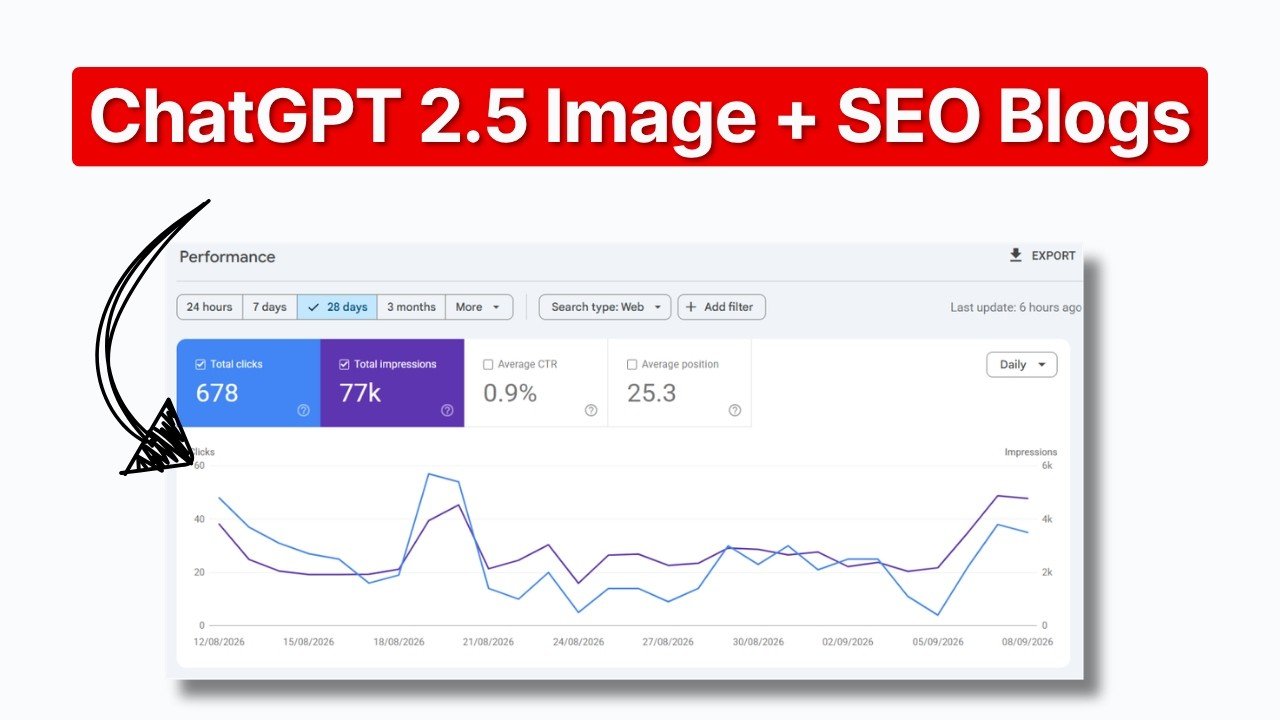
Raj says he has used ChatGPT images on blogs for about six months, alongside Semrush for keyword research. He then looks at recent performance and attributes an improvement, in part, to the newer ChatGPT Images 2.5 model. He compares a short window of impressions and clicks with a period before that model.
Those numbers are a snapshot from his properties. Image search and Discover-style traffic move around, and a 24-hour or 28-day slice can flatter or punish you. Use the video as a process demo, not as proof that “Images 2.5 equals more clicks.”
Steps from the video
- Start with a topic you have a reason to cover — in the video, a Trends-based idea — and write the page first.
- Generate images that actually illustrate the point, then compress them and add descriptive alt text. Do not invent screenshots of data you do not have.
- If you use Google web stories, keep the story faithful to the article and usable on mobile.
- Measure in Search Console over weeks, not hours, and look at queries and pages rather than a single “AI images” label.
The impression and click figures in the video (including a 24-hour snapshot he describes as about 4,000 impressions and 29 clicks, and a comparison with the period before Images 2.5) are Raj’s own observations. They are not a typical result and not a forecast for another site. Semrush is also mentioned for keyword research.
Images are support, not the strategy
A clear article, a real offer, and a fast page still do most of the SEO work. If you want a content and on-page plan, see SEO or AI social videos for the visual side, or email info@querylookup.com.
FAQ
Do AI images by themselves rank a page?
No. Useful images can support a good article or a web story. They will not rescue a thin post. Alt text, file size, and the surrounding copy still matter.
Where does he get article ideas?
Google Trends (trends.google.com), with a country selected, then he pairs topics with image generation for the post or a web story.
How this fits with QueryLookup
If you want help applying this on a business site, see the related service page, browse more videos, or contact QueryLookup. QueryLookup (Querylookup Research) is a Bengaluru studio working on Google SEO, websites, AI automations, WhatsApp workflows, Facebook ads, and AI social videos. This write-up is an edited companion to the YouTube video, not a caption dump, and it does not replace watching the walkthrough when you need the exact clicks.
The source video runs 4:35 and was published on 2026-09-14. It is one of the recent long-form uploads from the Querylookup Research channel, not a YouTube Short. Use the article to decide whether the method is relevant to your site, then watch the segment you need. None of these posts promise rankings, traffic, or income. Tool names, prices, model availability, and promotional offers change. When a video is sponsored or uses an affiliate link, that is stated in the article. For how we handle claims and recommendations on this site, read the editorial policy and disclaimer.
Before you copy the workflow
Check that the product screens in the video still exist. AI tools, SEO platforms, and domain registrars redesign their dashboards often, and a beta feature can disappear. Prefer official documentation and your own billing or admin screens over any single screenshot. If the video involves connecting WordPress, an API key, or a business profile, use a revocable credential and keep client data out of third-party tools you have not vetted. If you are a local business, pair any AI or content experiment with the basics that still move the needle: a complete Google Business Profile, accurate contact details, and service pages that say who you help.
If you decide the idea is worth trying on a company site, start with one page or one workflow, measure it, and keep a human editor in the loop. That is the same standard we use when we take on SEO or automation work. Questions about a project can go to info@querylookup.com.